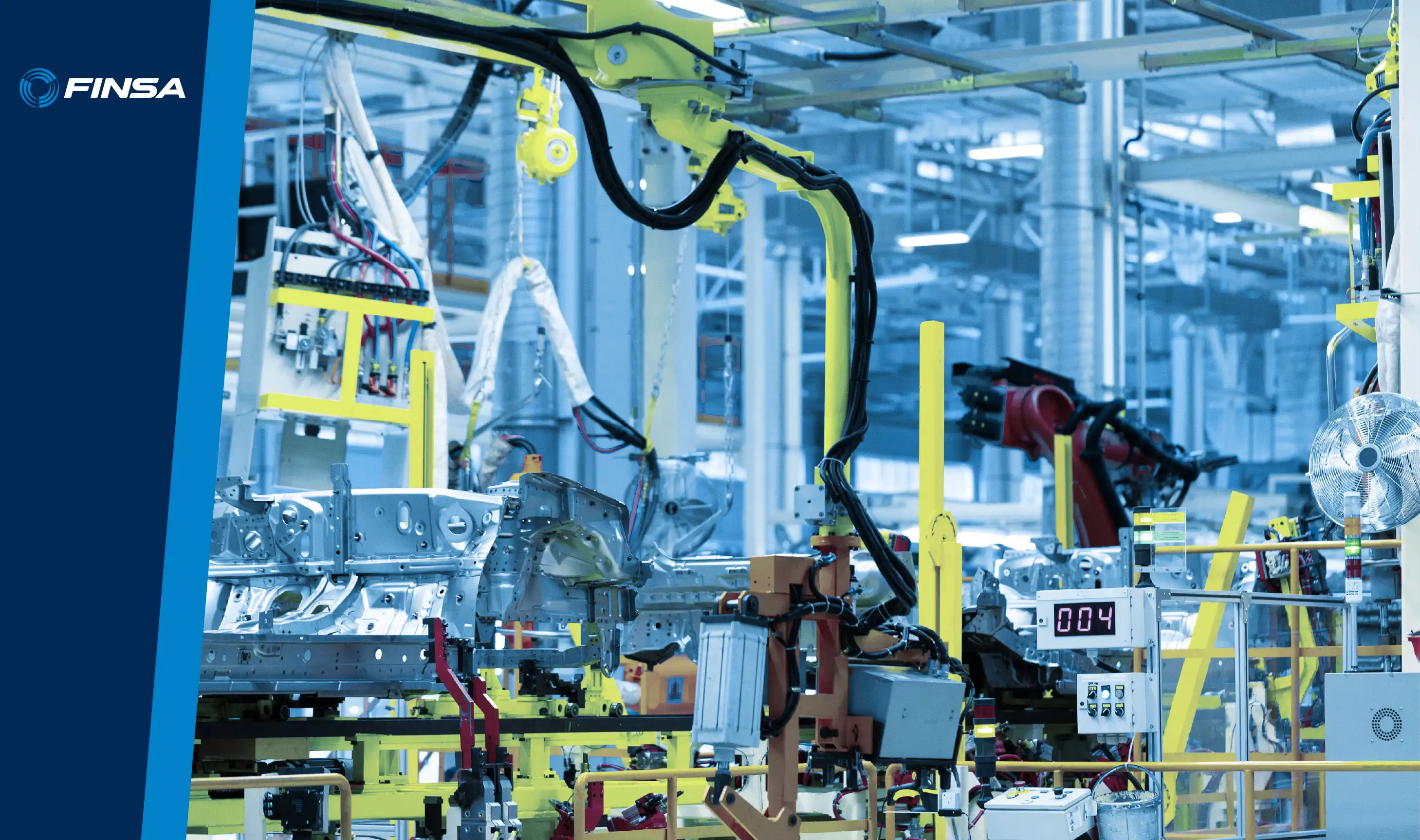
Advanced manufacturing in Mexico: infrastructure as a competitive advantage
14 de Junio de 2024
Advanced manufacturing in our country is entering a decisive stage. The reconfiguration of global value chains, the consolidation of the United States, Canada, and Mexico as a productive bloc, and the evolution of nearshoring are accelerating investments in sectors of greater technological complexity.
Competitiveness no longer depends solely on labor costs or geographic location. Today, advanced manufacturing demands robust infrastructure, specialized talent, environmental sustainability, and consolidated innovation ecosystems.
FINSA's Industrial Development Index (IDI) offers a clear snapshot of these capabilities and allows us to understand what States are ready to lead the next phase of industrialization.
What is advanced manufacturing in Mexico and how does it go beyond of traditional production?
Advanced manufacturing involves:
-
Digitalization of industrial processes
-
Intelligent automation
-
Real-time data integration
-
High-precision quality systems
-
Strategic Use of Artificial Intelligence
-
Greater Sophistication in Supply Chains
This production model demands structural conditions that go beyond the factory floor. It requires connectivity, energy stability, technical talent, and a competitive environment.
Why Is industrial infrastructure the foundation of advanced manufacturing in Mexico?
Infrastructure continues to be the primary enabler.
According to the IDI, the states with the largest consolidated industrial space are:
-
Nuevo León (17.9 million sqft)
-
Chihuahua (10.7 million sqft)
-
Baja California (7.7 million sqft)
-
State of Mexico (7.6 million sqft)
-
Tamaulipas (6.9 million sqft)
Furthermore, states like Nuevo León, the State of Mexico, and Chihuahua lead in new annual industrial construction, confirming a sustained expansion of installed capacity.
In advanced manufacturing, the availability of Class A and B space, air and port connectivity, and road quality are not optional: they are determinant.
How do the economic environment and exports influence advanced manufacturing in Mexico?
Advanced manufacturing in Mexico is highly linked to exports.
According to the most recent IDI data:
-
Chihuahua accounts for 13.9% of manufacturing exports
-
Coahuila 11.9%
-
Baja California 10.4%
-
Nuevo León 10%
-
Tamaulipas 7.1%
These five border states concentrate more than 53% of the country's manufactured exports.
This export concentration indicates deep integration into global value chains, particularly in sectors such as automotive, medical devices, electronics, and aerospace.
Plan México and Advanced Manufacturing
Plan México proposes four pillars strategic:
-
Productive relocation
-
Territorial development poles (PODECOBI)
-
Talent and innovation
-
Strategic import substitution
What What factors allow certain states to lead advanced manufacturing in Mexico?
-
Mature industrial capacity
-
Active public policy
-
Infrastructure enabled
-
Specialized talent
This areas are where advanced manufacturing can scale most rapidly.
Which states are better positioned?
The IDI classifies states into four levels: high, upper-middle, lower-middle, and low industrial development.
States like Nuevo León, Chihuahua, and Coahuila remain at high levels due to:
-
Leadership in industrial space
-
High export volume
-
Greater economic complexity
-
Consolidated Industrial Ecosystems
While other regions still face structural challenges in infrastructure, security, or talent.
What is FINSA's role in the development of advanced manufacturing in Mexico?
Advanced manufacturing is materialized in square meters, available electrical capacity, logistical connectivity, and industrial ecosystems ready to operate from day one.
In this context, infrastructure becomes the merging point between national strategy and business execution.
FINSA has consolidated its presence precisely in the states that today lead the country's industrial development —Nuevo León, Chihuahua, Baja California, State of Mexico, Tamaulipas, Querétaro, Jalisco, and Coahuila—regions that combine industrial space, export vocation, technical talent, and strategic connectivity with North America.
Why Is FINSA's strategic location key to advanced manufacturing in Mexico?
Our industrial parks are located in key corridors for advanced manufacturing: the northern border, the Bajío region, and the central part of the country, where automotive, electronics, aerospace, and medical device supply chains converge.
Beyond the availability of Class A ships, the focus is in creating environments prepared for highly complex technological operations, with robust energy infrastructure, sustainability certifications, territorial planning, and integrated logistics connectivity.
At a time when Mexico is redefining its role within North American productive integration, advanced manufacturing requires more than intention: it needs infrastructure ready to scale.
FINSA is driving this infrastructure with a long-term vision, aligning strategic location, industrial capacity, and sustainability to support the companies that are building the next stage of industry in Mexico.








Subscribe to our newsletter

We are FINSA
Subscribe to our newsletter
Don't miss out on news, new developments and updates.
Subscribe to our newsletter
Don't miss out on news, new developments and updates.
We are FINSA