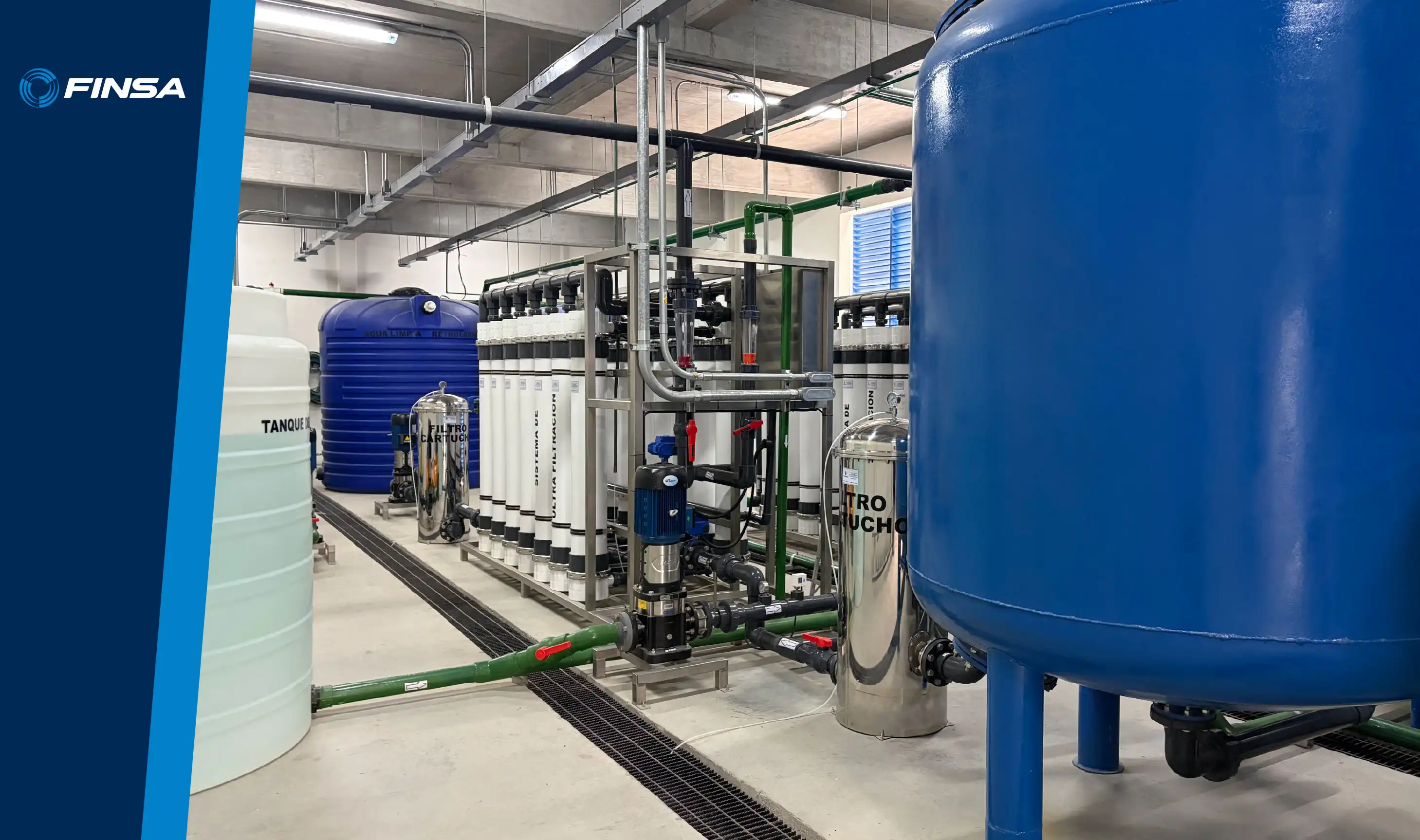
In the face of water scarcity, FINSA promotes a water reuse model in industrial parks.
14 de Junio de 2024
In light of the increasing water pressure in the northern part of the country and its potential impact on the operational continuity of the industry, FINSA has implemented an advanced water treatment model in its industrial park in Santa Catarina, with an investment exceeding 30 million pesos.
The system will allow for the recovery of approximately 520 m³ of water daily (around 6 liters per second), reducing discharges into receiving bodies by up to 80% and significantly decreasing the consumption of potable water within the park.
In operational terms, the project opens the door to reducing the water footprint by up to 80%, with the potential to approach total resource reuse schemes, a factor that is becoming increasingly crucial for the viability of industrial developments in water-stressed regions.
Water: the new critical factor for nearshoring
In the current context, water availability is beginning to emerge as one of the main bottlenecks for the growth of nearshoring in Mexico, particularly in northern states where industrial demand coincides with scarcity conditions.
Under this scenario, the FINSA project not only responds to environmental criteria but also to a logic of managing operational risks by ensuring greater certainty in the water supply for companies located in its parks.
"The industrial infrastructure of the future no longer competes solely on location or connectivity but on its ability to secure critical resources like water. This type of investment responds to that new reality," said Sergio Argüelles, CEO of FINSA.
Initially conceived as a pilot plan, the system is now shaping up to be a scalable model for other industrial parks, particularly in areas with critical water stress.
FINSA is already evaluating its possible implementation in other developments as part of a strategy to strengthen the water resilience of its portfolio and maintain its competitiveness in the face of growing industrial demand.
"What started as a pilot today we see as a standard for future development. In regions with water stress, these types of solutions will no longer be optional and will become part of the base design of industrial infrastructure," stated Rodolfo Morales, Director of ASG at FINSA.
Technology and international standards
The project incorporates ultrafiltration and reverse osmosis processes, aligned with standards such as ISO 16075 (water reuse) and ISO 23070:2020 (advanced treatment), which allows for obtaining water of a quality comparable to that established by NOM-127-SSA1-2021.
Although treated water can reach levels close to potable use, Mexican regulations limit its consumption and human use when it comes from treated wastewater sources.
The long-term goal is to evolve toward a "zero discharge" model, where the water used within the park is fully treated and reused.
The recovered resource can be used for purposes such as:
- Irrigation in construction processes
- Manufacturing (such as concrete production)
- Cooling or equipment washing systems.
- Internal services of the park
- Irrigation of green areas
This approach allows for reducing operational costs associated with water, while mitigating regulatory and availability risks.
Competitive advantage in a restrictive environment
The Santa Catarina industrial park already had four treatment plants under NOM-001-SEMARNAT-2021, a capacity that is uncommon in the sector. The incorporation of advanced treatment represents an evolution toward more efficient models.
In an environment where access to water is beginning to influence investment decisions, this type of infrastructure could become a key differentiating factor for attracting and retaining companies.
Currently, the application of such advanced technologies on an industrial park scale remains limited in Mexico, positioning the project as a potential benchmark for the sector.
"Today, the availability of water has ceased to be an environmental issue and has become a critical factor for competitiveness. If we do not secure this resource, there are simply no conditions to sustain industrial growth in the long term," said Sergio Argüelles, CEO of FINSA.








Subscribe to our newsletter

We are FINSA
Subscribe to our newsletter
Don't miss out on news, new developments and updates.
Subscribe to our newsletter
Don't miss out on news, new developments and updates.
We are FINSA